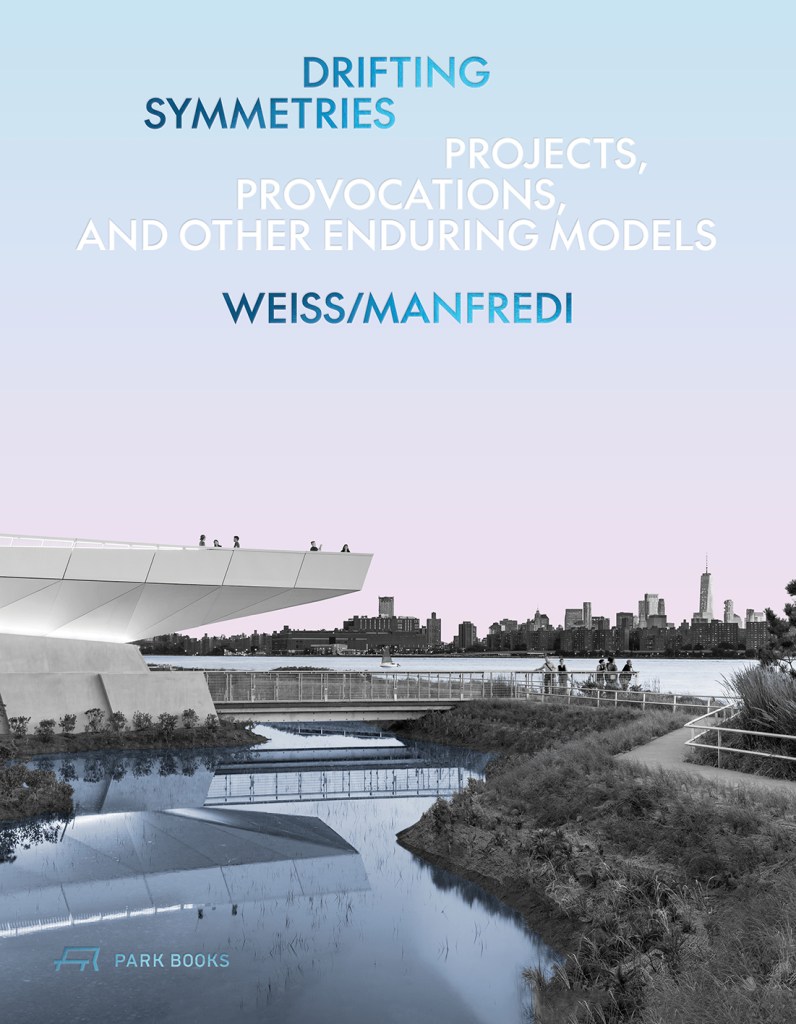
Published by Park Books, the book ‘Drifting Symmetries‘ is a resonant and timely exploration by architects Marion Weiss and Michael Manfredi, whose practice has long operated at the intersection of architecture, landscape, and infrastructure. The book serves not only as a survey of their work but also as a manifesto for an architectural discipline capable of responding to the complex environmental and social challenges of our time.


At the core of the volume is the notion of “drifting symmetry,” a concept through which the architects question classical ideals of formal perfection. Traditional symmetry, they argue, stabilizes identity and imposes boundaries that can resist the unpredictable dynamics of cultural and ecological forces. When symmetry “drifts,” however, when forms shift, adapt, and absorb external pressures, it becomes an instrument for open-ended, resilient design. This principle reflects Weiss/Manfredi’s consistent willingness to delay resolution until a project has fully engaged the broader landscapes, histories, and communities surrounding it.
The book unfolds along two interwoven trajectories. The first examines twelve historical hybrid case studies spanning more than six centuries and nine countries. These “enduring models” demonstrate how architecture has long thrived in the liminal territories between disciplines. Works such as the Indian stepwell Agrasen Ki Baoli—part water infrastructure, part civic stage—and Jože Plečnik’s Ljubljana Riverwalk illustrate how hybrid typologies create spaces of adaptability, public exchange, and ecological intelligence.

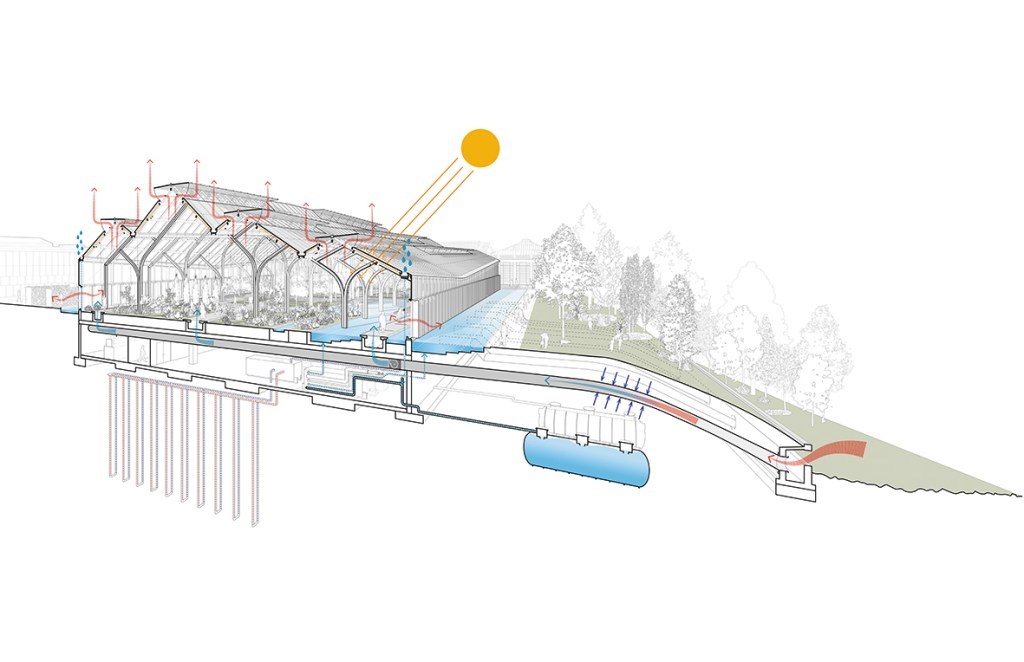
The second narrative presents Weiss/Manfredi’s own projects, each paired with the conceptual “premises” that shaped its development. Their designs emerge as “typological chameleons”: legible yet flexible forms that evolve alongside changing environmental and social conditions. Whether crafting waterfront landscapes, university precincts, or urban public spaces, the architects dissolve boundaries between built form, terrain, and infrastructure, generating new grounds for public life.
Anchoring the book is a robust section of “reflections” from influential thinkers, including Thom Mayne, Tatiana Bilbao, Walter Hood, Barry Bergdoll, and Sarah Whiting, who expand and challenge the themes of hybridity, resilience, and disciplinary overlap. Their insights reinforce the book’s central claim: that a more connected and ecologically attuned future demands an architecture willing to drift beyond its conventional limits.
In synthesizing historical research, contemporary practice, and interdisciplinary dialogue, Drifting Symmetries stands as both a rich intellectual resource and an inspiring call to reimagine the role of architecture today.
 The Flora Journal