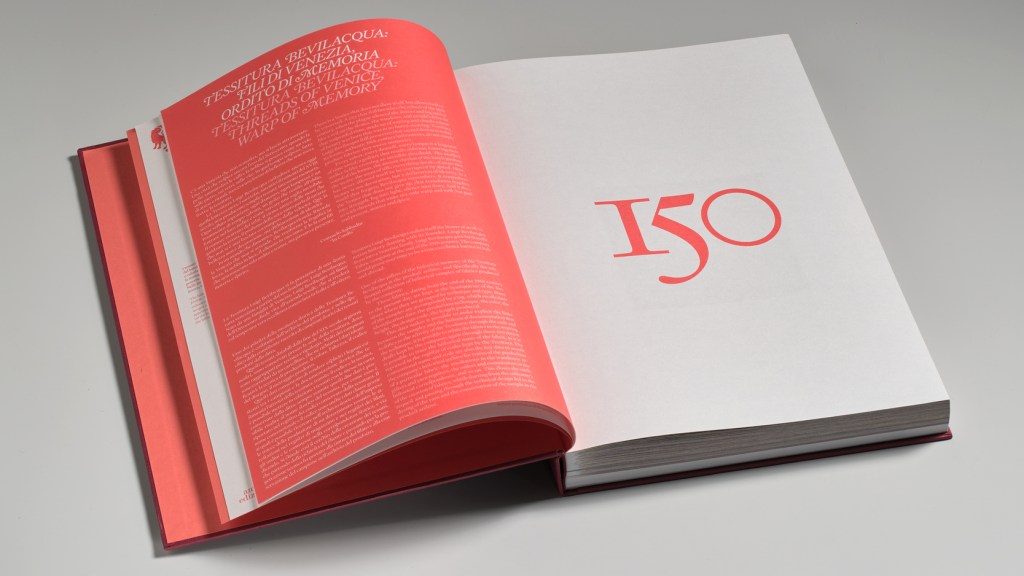
In Venice, Italy a city whose identity has long been shaped by trade, craftsmanship, and beauty, textile production has played a central cultural role for centuries. Among the few historic weaving houses still active today, Tessitura Luigi Bevilacqua stands out as a rare example of uninterrupted excellence. In 2025, the renowned Venetian manufactory celebrated its 150th anniversary with the publication of an ambitious and visually striking book that chronicles its extraordinary history through fabrics, documents, and archival material.

credit Filippo Guerra- studio Otium
credit Filippo Guerra- studio Otium
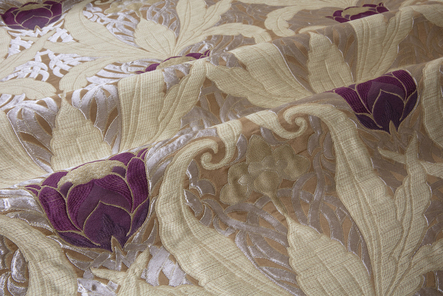
Founded in 1875 by Luigi Bevilacqua, the company inherited and revived ancient looms once used in earlier Venetian silk workshops. Although the firm’s official establishment dates to the late 19th century, the Bevilacqua family’s involvement in textile production in Venice can be traced back to the end of the 15th century, firmly anchoring the brand within the city’s artisanal DNA. From the very beginning, the Tessitura specialized in the production of high-quality velvets, damasks, lampas, and brocades, using traditional handlooms that are still in operation today.
The anniversary book was conceived not merely as a commemorative object, but as a cultural and historical testament. At its core are 150 iconic fabrics, reproduced at full scale, each representing a specific moment in the company’s evolution. The volume allows readers to appreciate the richness of textures, the depth of color, and the technical complexity that define Bevilacqua’s work, making the book itself a tactile and visual experience.

credit Filippo Guerra- studio Otium
credit Filippo Guerra- studio Otium
Printed by Grafiche Antiga, an Italian excellence renowned for its masterful balance of advanced technology and artisanal savoir-faire, the volume was conceived as a true collector’s item. Every editorial choice, from the selection of paper to the elegance of the layout, from the quality of the binding to the precision of color reproduction, was carefully calibrated to enhance each plate and archival document. The result is a book capable of conveying the three-dimensionality of the fabrics and the extraordinary refinement of the designs, transforming the publication into an immersive aesthetic experience rather than a traditional historical volume.
A defining feature of the project is its close connection to the newly developed digital historical archive of Tessitura Luigi Bevilacqua. In recent years, the company has undertaken extensive archival research to preserve and digitize a vast collection of original materials, including design drawings, fabric samples, correspondence, accounting records, photographs, and technical notes. Many of these documents, previously accessible only to specialists, now form a structured and searchable archive that ensures the long-term preservation of fragile materials while opening them to scholars, designers, and cultural institutions worldwide.

credit Filippo Guerra- studio Otium

credit Filippo Guerra- studio Otium
Through this archive, the book expands beyond storytelling to become a gateway into Bevilacqua’s living memory. It documents relationships with prominent historical figures, religious institutions, royal households, and major cultural commissions, highlighting how the Tessitura’s fabrics have adorned palaces, theaters, churches, and prestigious interiors across Europe and beyond. The archive also reveals the evolution of taste, production techniques, and design trends over more than a century.
Today, under the leadership of the latest generation of the Bevilacqua family, the Tessitura continues to balance tradition and innovation. The looms remain manual, the techniques unchanged, yet the company actively engages with contemporary designers and new applications. The digital archive and the anniversary book together reflect this philosophy: honoring the past while making it accessible and relevant for the future. After 150 years, Tessitura Luigi Bevilacqua is not simply preserving history: it is weaving it forward, thread by thread, page by page.
 The Flora Journal