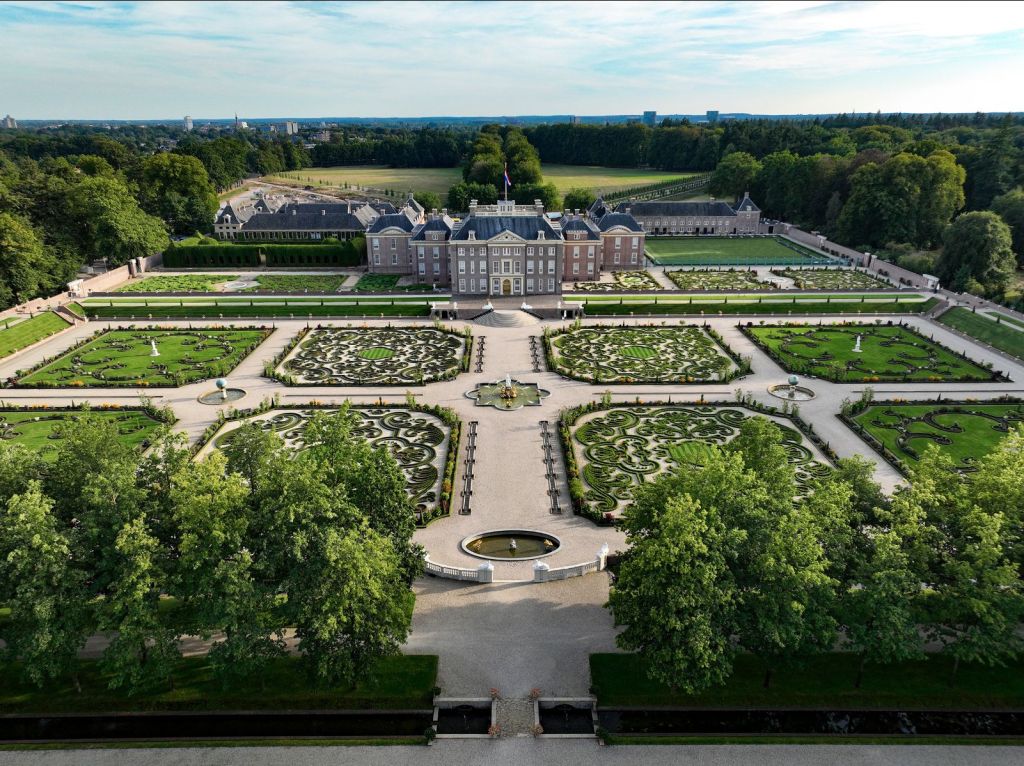
At Paleis Het Loo, in Apeldoorn, The Netherlands, the newly opened exhibition State of Wander, on view until 27 September 2026, unfolds as an ambitious, research-driven project that transforms the former Dutch royal residence into a living, breathing ecological archive. Developed through an extended process of interdisciplinary collaboration, the exhibition brings together ten artists, designers, and academics whose newly commissioned works are installed across the palace’s interiors and its vast outdoor landscape, throughout the palace interiors, stables, gardens, grotto, rooftop and surrounding woodland.
A research-based, cross-disciplinary contemporary art project initiated and conceived by guest curator Anna Bitkina and developed in collaboration with Annette de Vries, Associate Director of Research, Collection and Programming and Renske Ek, Curator at Paleis Het Loo, State of Wander interrogates how royal heritage intersects with environmental degradation, colonial histories, governance systems, and the entangled existence of multiple species. The project builds on more than a year of collective research, inviting visitors not simply to observe but to wander, physically and intellectually , through layered narratives of power, ecology, and time.
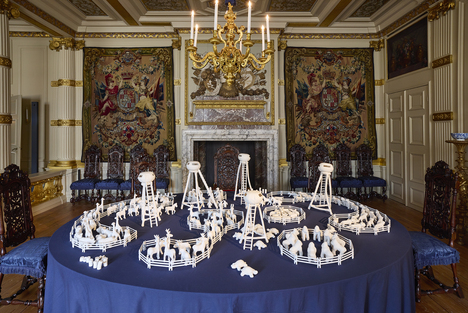
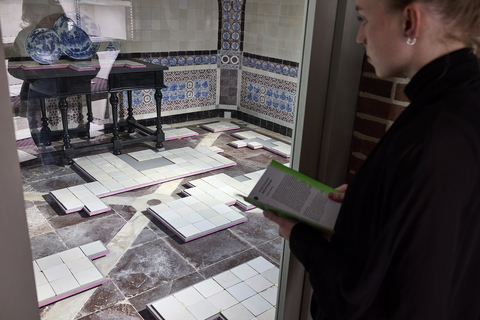
The exhibition challenges traditional museological approaches by dispersing artworks throughout the estate. In Queen Mary’s Cellar Kitchen, Antye Guenther’s Salt of Interest cultivates salt crystals directly on historic tiles, transforming conservation damage into a poetic reflection on climate instability and material decay. In the former royal dining room and chapel, Bryony Dunne’s Tables of Power stages intricate sugar sculptures that recall courtly display traditions while exposing the violence embedded in colonial extraction systems.
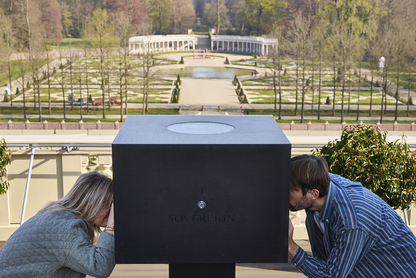
Elsewhere, Caitlin Berrigan’s 1,311 Diamonds in the East Foyer weaves together sculpture, sound, and indigo textiles to explore the deep entanglement between maritime trade, slavery, and environmental crisis. On the palace rooftop, Clemens Driessen and Teodora Cecilia Buccilli’s Unboxing the Sovereign Gaze revisits 17th-century perspective techniques, questioning how visual systems have historically constructed authority over landscapes.
courtesy of Paleis Het Loo
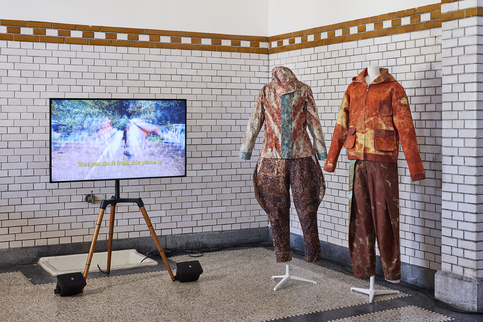
The courtyard hosts Edward Clydesdale Thomson’s home/host, an animatronic installation that uses real-time institutional data to reframe the palace as a sensing organism, revealing hidden dynamics of inclusion and exclusion. Meanwhile, Gayatri Kodikal’s Searching for Lost Seeds unfolds as a GPS-sensitive augmented reality experience spanning multiple locations across the estate, blending textile, video, and virtual elements to examine colonial narratives and constructed notions of “wildness.”
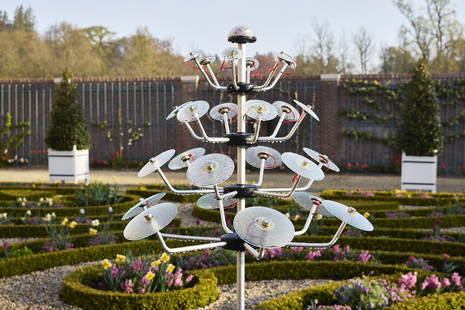
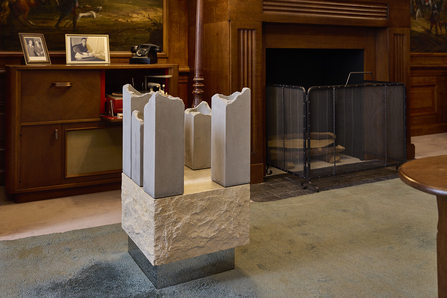
Sound and sensory experiences play a central role throughout the exhibition. Jan Christian Schulz’s Biophony of Het Loo transforms the ‘Grotto’ into a live ecological listening chamber, replacing static displays with real-time environmental soundscapes. Marianna Maruyama’s Diana introduces scent as a narrative medium, with custom perfumes referencing the Roman goddess and the palace’s hunting legacy, while Rob Voerman’s W recycled-material pavilion in the Upper Garden offers a stark counterpoint to baroque aesthetics, highlighting inequalities in land use and access.
courtesy of Paleis Het Loo
courtesy of Paleis Het Loo
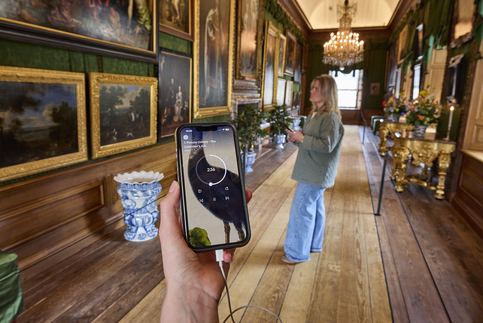
Terike Haapoja’s contribution, Foreign Beasts and Other Rarities, reimagines the museum audio guide by shifting focus from royal biography to multispecies perspectives shaped by colonial trade and capitalism. This decentering of the human viewpoint resonates across the entire exhibition, reinforcing its central premise: that heritage is not static, but part of an ongoing ecological and cultural process.
Complementing the exhibition is the State of Wander podwalk available on Spotify, featuring Cathelijne Blok. This audio experience extends the exhibition beyond the visual realm, guiding listeners through the site while deepening engagement with its themes of movement, reflection, and interconnectedness.
courtesy of Paleis Het Loo
courtesy of Paleis Het Loo
As Annette de Vries, Associate Director of Research, Collection and Programming, emphasizes, “cultural heritage requires thinking in long lines: past, present and future,” and in this sense, State of Wander “offers fresh perspectives on heritage and invites wandering: inside, outside and in thought.” Echoing this, guest curator Anna Bitkina describes the exhibition as “a kind of expedition,” where visitors, “equipped with a roadmap, go on a trip through the estate to explore how collections of royal houses and Western museums have shaped our understanding of nature.” She further notes that the project encourages audiences to “trace how deeply rooted ideas of human dominance, embedded in cultural and educational institutions, continue to inform the way we relate to the natural world today.” Together, their curatorial vision frames the exhibition as both a critical inquiry and an open-ended journey: one that unfolds across space, history, and ecological imagination.
In a complementary perspective, Renske Ek, Curator at Paleis Het Loo, highlights the depth of the artists’ research, noting that they “dove deep into the soul of Paleis Het Loo,” engaging with scientists and staff at all levels, from the facilities team to those who know the palace most intimately, including the museum cleaning team, and producing works that “speak in richly layered ways to our complex and often conflicted relationship with the natural world and the landscapes of which we are part‘.
In doing so, the exhibition transforms Paleis Het Loo into a site where history, art, and ecology converge, offering visitors a rare opportunity to reconsider the complex relationships between power, landscape, and life.

