Henry Moore‘s monumental sculptures return to the natural landscape through two major exhibitions at the Royal Botanic Gardens, Kew, in London, and Wakehurst in Sussex, UK. Together, they offer an opportunity to explore the relationship between art, landscape and ecology, moving beyond the traditional idea of the garden as a mere setting for sculpture.
Monumental Nature, on view at Kew Gardens until 31 January 2027, is the largest outdoor exhibition ever dedicated to British sculptor Henry Moore (1898–1986). Thirty monumental works are displayed across the 320-acre UNESCO World Heritage Site, among historic trees, sweeping lawns, landscaped vistas and within the celebrated Temperate House. Organised in partnership with the Henry Moore Foundation, the exhibition offers a fresh perspective on the profound connection between sculptural forms and the natural world.
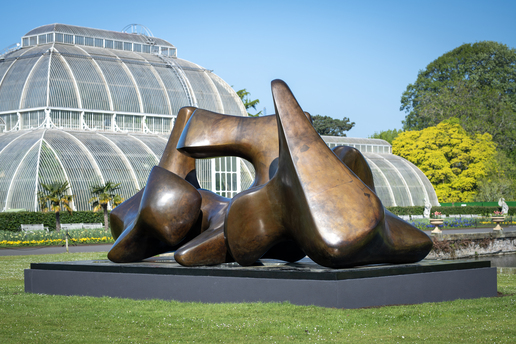
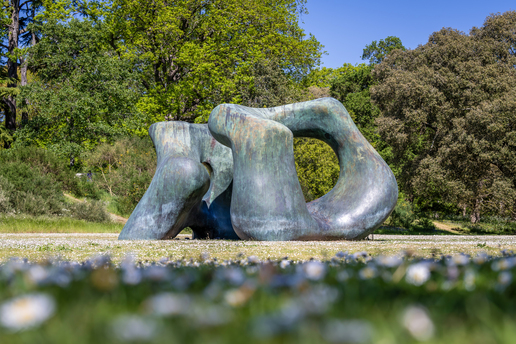
credit Ines Stuart-Davidson
As Paul Denton, Director of Creative Programmes and Exhibitions at RBG Kew, explains: “His enduring interest in placing the human figure within the landscape speaks to our timeless and shared connection with the natural world.”
Among the works on display are Large Two Forms, Sheep Piece, Large Reclining Figure and Three-Piece Sculpture: Vertebrae. Their organic shapes, inspired by the human body, bones, stones and natural processes, appear to find their ideal setting within the landscape. Yet the relationship between sculpture and its surroundings extends far beyond visual harmony.
For Moore, landscape was never simply a decorative backdrop. His sculptures were intended to be experienced outdoors, where natural light, shadows, changing weather conditions and shifting viewpoints continually alter their appearance. This reciprocal relationship offers a particularly compelling interpretation through landscape architecture: sculpture does not merely transform our perception of space; the landscape itself, through its living processes, continuously reshapes the way we experience and understand the artwork.
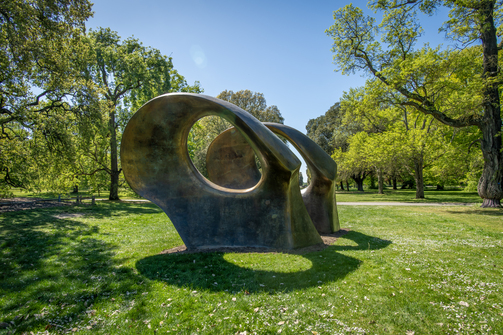
credit Ines Stuart-Davidson
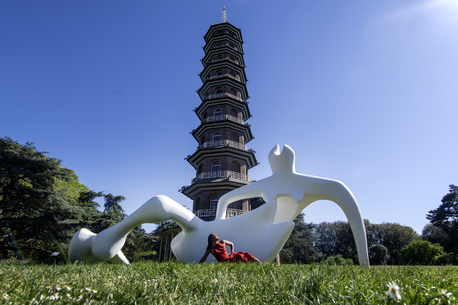
credit Kew Gardens
Vegetation grows, the seasons alter colours and textures, while bronze and stone are gradually transformed by exposure to the elements. Sculpture and landscape thus become part of a dynamic spatial experience in which nature, materiality and human presence contribute to the creation of meaning.
The exhibition continues in the Shirley Sherwood Gallery of Botanical Art, where more than ninety works, including drawings, prints and sculptures, explore Moore’s observation of nature and its influence on his creative process.
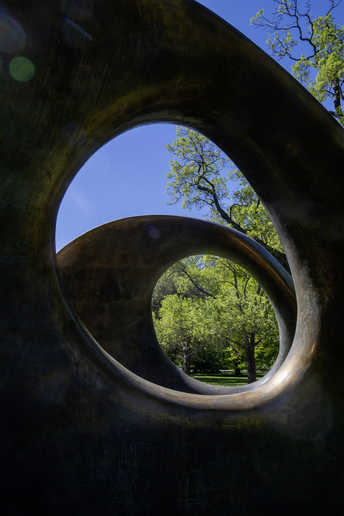
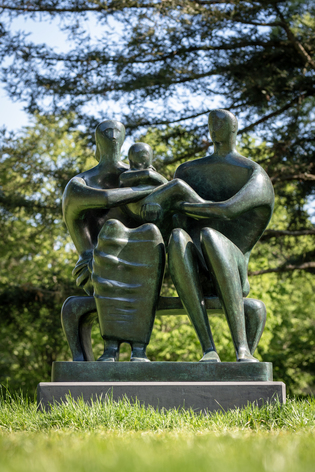
credit Ines Stuart-Davidson
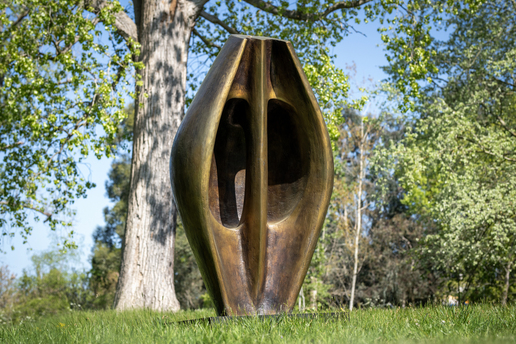
Meanwhile, Henry Moore and more, on view at Wakehurst until 23 May 2027, presents four sculptures by Moore alongside contemporary works by Rana Begum, Rafael Pérez Evans and Paloma Varga Weisz. In contrast to Kew’s historic and carefully designed landscape, Wakehurst offers an environment shaped by natural habitats, botanical research and biodiversity conservation. As Eva Owen, Programme Manager at Wakehurst, observes, the Millennium Seed Bank “stands as a potent symbol of caring for and conserving the natural world.” Her words reinforce the exhibition’s broader ecological dimension, connecting artistic expression with environmental responsibility.
Another important point of reference is Henry Moore Studios & Gardens in Hertfordshire, where the artist lived and worked from 1940 onwards. Here, the relationship between sculpture and landscape was an integral part of his everyday creative practice. His works could be experienced outdoors, in direct dialogue with the topography, vegetation and changing qualities of natural light.
Reflecting on Moore’s artistic legacy, Sebastiano Barassi, Head of Henry Moore Collections & Programmes, notes: “Throughout his career, he was inspired by organic forms: bones, stones, trees, and the rhythms of the landscape and he believed that sculpture should exist in harmony with its surroundings.”
The exhibitions at Kew and Wakehurst therefore invite visitors to reconsider the traditional distinction between artwork and setting. Landscape is not a static container, but a living system that actively participates in the aesthetic experience.
From this perspective, Henry Moore’s legacy acquires renewed relevance. Botanical gardens and cultural landscapes become places where art, ecology and scientific knowledge intersect, encouraging a deeper awareness of our relationship with the natural environment.

